
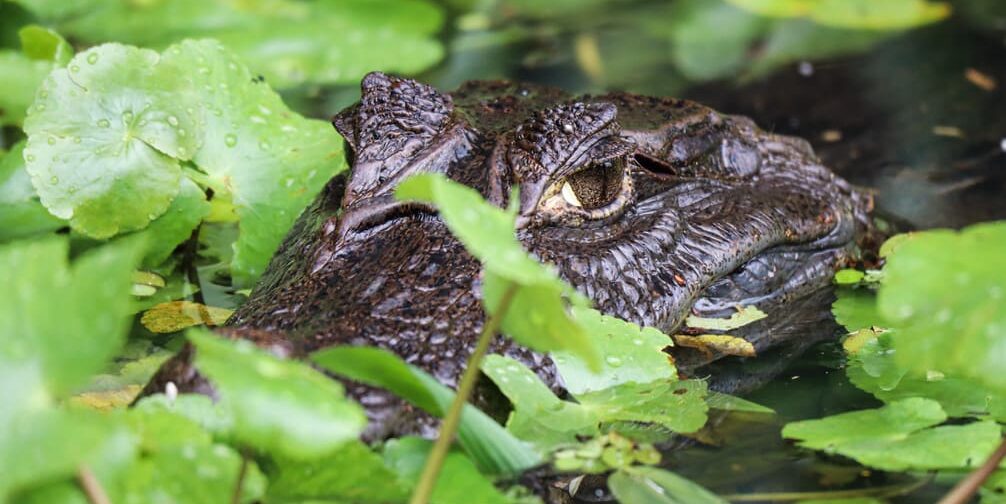
Costa Rica is a rather small country, but it’s famous for its rich biodiversity and extensive network of national parks and protected areas. The country’s diverse ecosystems support a wide variety of wildlife. So of course, visiting at least one of the many national parks is a must on your trip to beautiful Costa Rica. But animals do their own thing and spotting them isn’t always easy. After visiting several national parks during my three months there, I can give you a bunch of tips on the best places to see wildlife in Costa Rica and how to spot as many as possible.
Table of Contents
What animals live in Costa Rica?
Costa Rica is home to over 500,000 species, making it one of the most biodiverse countries on Earth. In the treetops, you’ll spot howler monkeys, white-faced capuchin monkeys, and the famously slow-moving three-toed sloth. On the ground you’re likely to see coatis and racoons. If you’re lucky, you can even spot a tapir in the rainforest. Birdwatchers will be amazed by colourful species like the scarlet macaw and toucans. Reptiles and amphibians are abundant too, from crocodiles, snakes, green iguanas and Jesus lizards to red-eyed tree frogs and poison dart frogs. Costa Rica’s forests are also home to big cats like the jaguar, ocelot, and puma, though sightings are rare. Along the coasts you may see sea turtles, dolphins, and even migrating humpback whales.


Best places to see wildlife in Costa Rica
Some of the best places to see wildlife in Costa Rica are the national parks and protected reserves, where biodiversity thrives in natural habitats. Corcovado National Park on the Osa Peninsula is a top destination as it’s often referred to be the most biologically dense place on Earth. Tortuguero National Park, on the Caribbean coast, is famous for sea turtles and canal boat safaris where you can see an abundance of different birds, crocodiles and more. Manuel Antonio or Cahuita National Park offer easy trails for spotting lots of animals on your own. Besides the national parks you always have a chance to see animals at the side of the road, on the beach or even in town.
How to spot wild animals in Costa Rica
After visiting several national parks and speaking to a few guides I’ve collected some tips and made my own expierence on how to spot the most animals. So, here are a few tips that makes finding wildlife in Costa Rica a lot easier:
Take the easy path and go with a guide
The easiest way to see wildlife in one of Costa Rica’s national parks is going with a tour guide. Of course, it’s the more expensive way, but you’ll have the guarantee to see animals. The guides know exactly where to look, they know the typical spots and sometimes you really think they’ve got the eyes of an eagle. They often have a monocular with them, so you can get a closer look at animals that are high above you in the trees. Otherwise take your own binoculars or even a zoom lens, especially if you want to get good pictures.
Corcovado National Park, which is often said to be the most biologically intense place on Earth, is the only national park where you need a guide to be able to visit the park. But there is another one, where I’d really recommend you to book a tour. The Tortuguero National Park is only accessible via a big river system. Even though there is a path where you can walk a bit through the rainforest, most animals can be spotted from the river itself, so make sure to do a canoe tour when visiting Tortuguero.

Go alone and take it slow to see wild animals in Costa Rica
By going alone, I don’t just mean skip the guide and just go in with your friends or family, I mean to literally go in there alone. Yes, it’s fun to have company and someone to share the experience with, but when other people are with you, you can easily get distracted. You’ll probably talk a lot which can result in being too loud, listening less to all the noises around you and you won’t be able to observe your surroundings that carefully. That doesn’t mean you always have to go completely on your own to be able to spot animals, I went with friends as well and we had a great time. But I’ve usually seen more animals every time I went alone, so try it at least once.
Take your time, be quiet and really observe what’s around you. Listen to every noise; you often hear animals before you see them and look up to the trees, on the floor, in the bushes – there can be animals everywhere.
Visit a park for several times or different national parks
If you’ve got enough time and I’d really recommend you to not rush through this incredible country, visit different national parks or even the same national park several times to increase your chance in spotting as much wild animals in Costa Rica as possible. Okay, most national parks cost between 10 to 20$ entry fee without a guide, so it’s better to visit many different national parks rather than spend that much money again on the same park. But there are two national parks in Costa Rica that is worth to visit several days in a row. Cahuita and Manzanillo National Park on the Caribbean side of the country are the only national parks that are donation based. You don’t need to pay if you don’t want to or you can choose how much you want to spend. Note that in Cahuita only one entrance is donation based. If you enter from Puerto Vargas, you still must pay a small fee. In Cahuita I was able to see different animals on different days. I also spotted the same sloths two days in a row, because I remembered their locations and it’s very likely that these slow animals just moved on to the next tree.


Come in the morning or evening and avoid peak times
Avoiding peak times is not just important if you want to stay away from the crowds, it also helps to spot more wild animals. Many people tend to be loud and what kinds of animals like that? None of I know, so they’re likely to hide then. When I was visiting Parque Nacional Volcán Tenorio there was a bunch of happily chatting people entering the national park with me. It was actually my first time in the jungle, and I really wanted to enjoy the nature, so I stayed behind and waited a bit until I was all by myself again. Just a few minutes after everyone was gone and it was quiet again, two Tapirs came out of the bushes right in front me. They didn’t seem to be too shy, but I still doubt that they would’ve come out with more than twenty, loud people around. Some animals also tend to be more active early in the morning or before it’s getting dark again and are resting around midday. As many national parks already close in the afternoon and hours before sunset, it’s best to go early, right after opening to increase the chance of seeing wildlife in Costa Rica.
Stay close to tour groups to see wildlife in Costa Rica
Even if you decide to not book a tour and go on your own it’s always a good idea to look out for groups with a guide and stay close to them. Sleeping sloths high up in the trees are hard to spot for first timers, so I was happy about every guide I saw pointing out one until it got easier for me to spot them myself. But even after visiting several national parks, I wasn’t able to see all animals that were around me. Especially small animals like snakes or frogs are well hidden, so you really need to know where and what exactly to look out for. Staying close to a tour group gives you the opportunity to see animals that you easily would’ve missed out on without a guide. But don’t make it too obvious and don’t stay close to a group for too long, because the others paid extra for the guide and you didn’t. Most of the time it was completely random when I was close to a tour group and saw the guide spotting something while I was walking towards a group.

Last but not least, try to not set your expectations too high. They are wild animals, no one can control them, so there’s never a guarantee to which animals you’re able to see. There are animals like monkeys that are more likely to spot than snakes. But I can guarantee you’ll see wildlife during you’re trip in Costa Rica. Just stay realistic, so you’re not disappointed in the end and fully enjoy this incredible experience.
Do you want to get more tips and inspiration for your trip to Costa Rica? Here are the best places you can visit on the Caribbean coast of Costa Rica.