Best Things to Do on the Caribbean Side of Costa Rica
Posted on
The Carribean side of Costa Rica has a completely different vibe compared to the Pacific side. It’s influenced by the Afro-Caribbean Culture, especially Jamaica and it has a generally more laid-back atmosphere. The East Coast also doesn’t have the typical dry season the Pacific Coast has. You’ll find dense rainforest meeting beautiful, isolated beaches and there’s lots of wildlife to see. So here are the best things to do on the Caribbean side of Costa Rica.
Table of Contents
Best time to visit the Caribbean side of Costa Rica
Costa Rica’s Caribbean Coast doesn’t have the typical dry season and rainy season as they have on the Pacific side. It’s raining here every month throughout the whole year, though there are still some months with less rain than others. Luckily, the wettest months at the Pacific Coast tend to be some of the dryest at the Caribbean, so it’s perfect to escape the heaviest time of the rainy season in September and especially October. February till April usually have less rain too in comparison to the summer months from June until August. Still, most people visit the Carribean side of Costa Rica during the high season from December until March/April, which is the dry season on the Pacific side. The hostels were packed when I traveled along the Caribbean Coast in March and I was one of the only guests when I visited in October.
Tortuguero National Park - Costa Rica rainforest and turtle nesting
Tortuguero is famous for turtle nesting as the beach here is one of the most important nesting sites for green sea turtles. But other sea turtles like the leatherback sea turtle or the hawksbill sea turtle nest here as well. From July to October hundreds of green turtles are coming to the beach in Tortuguero to lay their eggs. About two months later, baby turtle’s hatch and make their way into the sea.
The village of Tortuguero itself is quite small with narrow walkways between the houses as cars don’t exist here. From the village you can have a walk along the beach or on a path through parts of the national park. Swimming in the sea is unfortunately not possible here due to strong currents and many sharks close to shore.
But since most parts of Tortuguero National Park are only accessible by boat, I’d recommend doing a canoe tour to see more of the beautiful rainforest and have the chance to spot as much wildlife as possible. Especially birds and crocodiles are better to find along the river. Make sure it’s a canoe tour and not a motorboat as the canoes can get to narrower parts of the river system that motorboats aren’t allowed to go and they make less noise that can scare away animals.
Seeing the turtles laying their eggs is only possible with a guide, so they are not disturbed and stay protected. You do have to pay the entry fee to the National Park additionally to the tour, but it’s still one of the cheaper places in Costa Rica to do a tour, especially in comparison to what you get for your money.
I don’t take tours that often, because I love exploring places on my own and loved learning to spot animals in Costa Rica on my own, but taking the tour in Tortuguero was amazing and I think it’s one of the best national parks in Costa Rica to do a tour in.
Tortuguero National Park Opening Hours: daily from 6am to 12am and 1pm to 4pm. Tours usually start early in the morning around 6am or later in the afternoon and turtle nesting tours take place in the evening or at night.
Tortuguero National Park Entrance Fee: The entry fee is 15$ for non-resident foreigners and you need to book online at least one day in advance at…..
Tortuguero Tour Costs: The costs vary, I paid 20$ for a 3h canoe tour in the morning and a guided 2 hour walk with the same group and guide for extra 15$. A guide isn’t necessary to walk through the park. Turtle nesting tours should be around 35-45$.
How to get to Tortuguero National Park: Take a bus to Cariari (2 hours) from the Gran Caribe terminal in San José. In Cariari take a second bus to La Pavona (1,5 hours). From here you take a boat to Tortuguero (1,5 hours). The boats are waiting for the bus, so don’t worry for being late. If you have a car, you can park it in La Pavona close to where the boats are leaving for an additional fee. When coming from Puerto Viejo, it’s easier to take a bus to Limón, then a taxi to Moin to take a boat from there. The boat ride from here is longer (3-4 hours) and a bit more expensive than from La Pavona.
Cahuita – Best National Park to see animals in Costa Rica
Cahuita is a small town located in the south of Costa Rica’s Caribbean side. Most people go there to visit Cahuita National Park, one of two national parks in Costa Rica that are donation based. The donation is voluntary, so you can choose if you want to pay something and how much.
Cahuita National Park is one of my favourites, as it’s easy to spot wildlife there, even without a guide. It’s an 8km walk along beautiful beaches and right through the jungle. You can also relax at one of the white sand beaches within the park and go for a swim. There’s also a reef close to shore, though it isn’t allowed to go snorkeling there on your own, but you can take a tour. The cheap entry makes it possible to visit the park two days in a row if you want to spend more time there and increase your chance on spotting animals.
The town of Cahuita itself has a chill vibe with some restaurants and a black sand beach called Playa Negra where you can even take a beginner’s surfing lesson if you want to try that. There’s a high chance that you can spot more sloths in the trees along the road next to Playa Negra. If you have a car or want to walk even further, visit Playa Grande as well, a huge black sand beach with barely anyone around.
Cahuita National Park Opening Hours: daily from 8am-4pm, though some parts in the middle close earlier around 2-3pm to make sure that everyone is out of the park by 4pm.
Cahuita National Park Entrance Fee: Voluntary donation when entering from Cahuita (Playa Blanca Entrance) and 5$ plus taxes when entering the park in Puerto Vargas
How to get to Cahuita: There’s a bus by Transportes MEPE running 4-5 times a day from Terminal de Autobus Atlantico Norte in San José to Cahuita passing through Limón. The journey will take about 4 hours. Check the bus times online in advance as they can change over time.
Puerto Viejo – The best Caribbean beaches in Costa Rica
Puerto Viejo is just half an hour drive south of Cahuita. The town is perfect as a base to visit the surrounding beaches, Cahuita National Park or Manzanillo National Park. It’s touristy though and you can find many souvenir shops in town. There’s also some nightlife, so if you prefer it a little more chill and quieter, stay in Cahuita or look for accommodation a little further out of town like at Playa Cocles. But be careful, when going out after dark and avoid being on your own as the area is one of the less safe ones in Costa Rica.
The best thing you can do in Puerto Viejo is renting a bicycle and exploring all these amazing beaches in the area. Right in the town of Puerto Viejo is a big black sand beach, but if you drive further south, you’ll find many white sand beaches like Playa Cocles, Playa Chiquita and Playa Punta Uva. At Punta Uva are some small cliffs you can hike up and spot some toucans or other animals if you are lucky. From around December until April there’s a good point break for surfing right at Punta Uva.
How to get to Puerto Viejo: A bus by Transportes MEPE is running 4-5 times a day from Terminal de Autobus Atlantico Norte in San José to Puerto Viejo. It’s the same bus that you need to get to Cahuita. The journey from San José will take you 4-5 hours.
Manzanillo – The hidden gem at the Caribbean Coast of Costa Rica
The small town of Manzanillo in the south of Costa Rica’s Caribbean Coast is only half an hour away from Puerto Viejo. It’s a rather quiet place where you can relax at a beautiful black sand beach and enjoy the vibrant colours of the Caribbean Sea. There is also an old shipwreck right at the beach and you can visit the Manzanillo National Park, which I’d still count as a hidden gem. The Manzanillo National Park is the second National Park with a donation-based entry. The donation is of course voluntarily, but always welcomed as it helps to fund the park and protect Costa Rica’s nature.
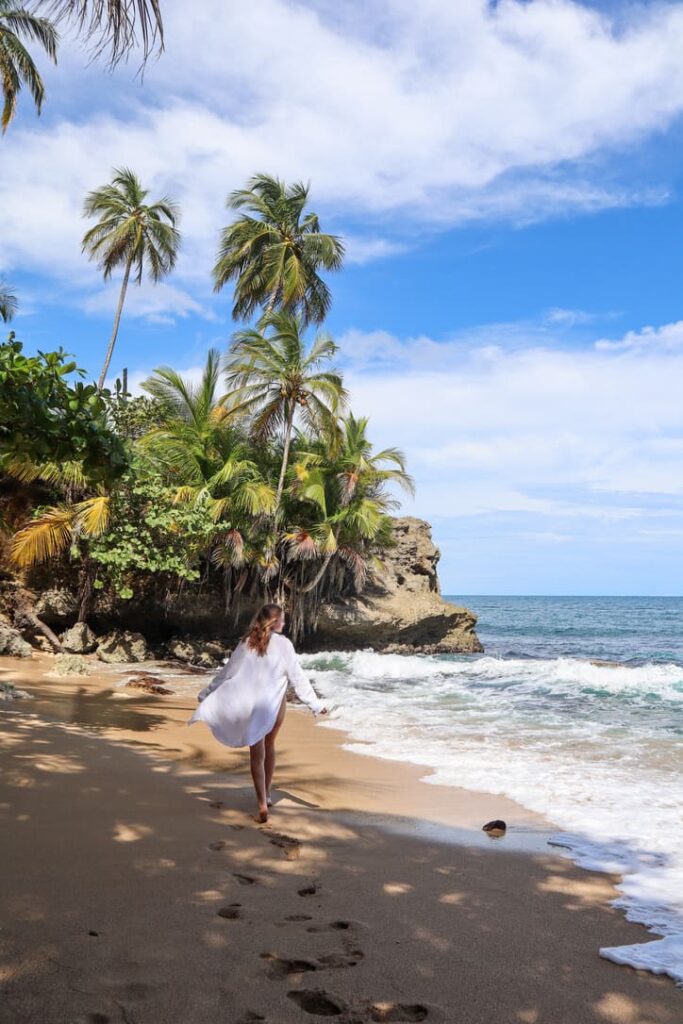
In my opinion, this National Park has some of the best Caribbean beaches in all of Costa Rica. I especially loved the small beach right after the viewpoint (marked on Google Maps as Mirador Manzanillo), but there are many more beaches if you walk even further and you can see some wildlife as well. You can even go almost all the way to Panamá though it’s quite a long hike.
Many people don’t know about this National Park and just visit the one in Cahuita, so there aren’t that many people around. Just make sure, you visit during the week, because on the weekend there are a lot of locals visiting the beaches in the park and it can get really crowded, especially in the first half of the park.
Manzanillo National Park Opening Hours: daily from 6:30am-3pm
Manzanillo National Park Entrance Fee: Voluntary donation
How to get to Manzanillo: Transportes MEPE is running a bus between Limón and Manzanillo several times a day, stopping in Cahuita and Puerto Viejo. If coming from San José, take the bus to Puerto Viejo and then continue to Manzanillo.
I hope that you’ll lovge Costa Rica as much as I did. Go check out more of my blogposts to get more travel tips and inspiration.